In the arid microclimates along Highway 93 and Highway 28, moisture gradients drive ant colonies indoors. Carpenter ants excavate softened Douglas fir and lodgepole pine framing in older residences along Courthouse…
In the arid microclimates along Highway 93 and Highway 28, moisture gradients drive ant colonies indoors. Carpenter ants excavate softened Douglas fir and lodgepole pine framing in older residences along Courthouse Hill, Brooklyn, and Downtown Salmon. Unlike termites, these wood-destroying insects do not consume cellulose; they excavate smooth nesting galleries, leaving distinct piles of fine sawdust known as frass. Odorous house ants and pavement ants emerge from flagstone walkways, concrete foundations, and riparian soils near the Salmon River and Carmen Creek, exploiting gaps as narrow as 1/16 of an inch around utility conduits and sill plates.
Effective ant control requires distinguishing between single-queen colonies and polygyne species that establish multi-satellite nests. Repellent pyrethroid sprays applied indoors frequently backfire against odorous house ants, triggering a defensive dispersion mechanism known as budding, which transforms a single kitchen infestation into four distinct wall-void colonies. Treatment utilizes non-repellent liquid actives alongside matrix-formulated carbohydrate or protein baits. Foraging worker ants walk through invisible residual chemistries and carry active ingredients back to the queen via trophallaxis, eradicating the reproductive hub over 7 to 14 days.
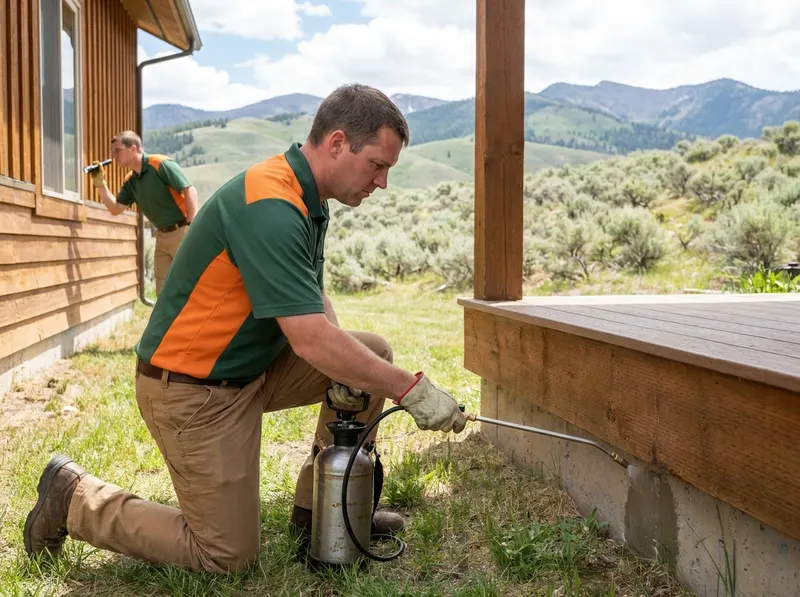
Properties in outlying areas such as Baker, Tendoy, Shoup, and the Lemhi Hole demand high-durability exterior applications. Structural protection combines clearing soil-to-wood contacts, establishing an unbroken 3-foot vertical and 3-foot horizontal perimeter band using rainfast wettable microcapsules, and injecting void treatments directly into suspected wall framing. The trade-off between exterior perimeter banding and indoor applications centers on nest location: an exterior-only treatment protects against seasonal migration from native soil, whereas established parent colonies inside structural timber demand targeted wall-void drilling to introduce slow-acting active ingredients directly to the nest.
Every job gets a firm, written price after a free on-site visit.
Tell us about your ant control job in Salmon and we'll send a clear, written quote, usually the same day.
 Ravexio Pest Defense