When cold weather descends through the Salmon River valley each October, field rodents migrate from riparian zones and sage flats into warm residential structures. Houses situated along Highway 93 and Highway 28…
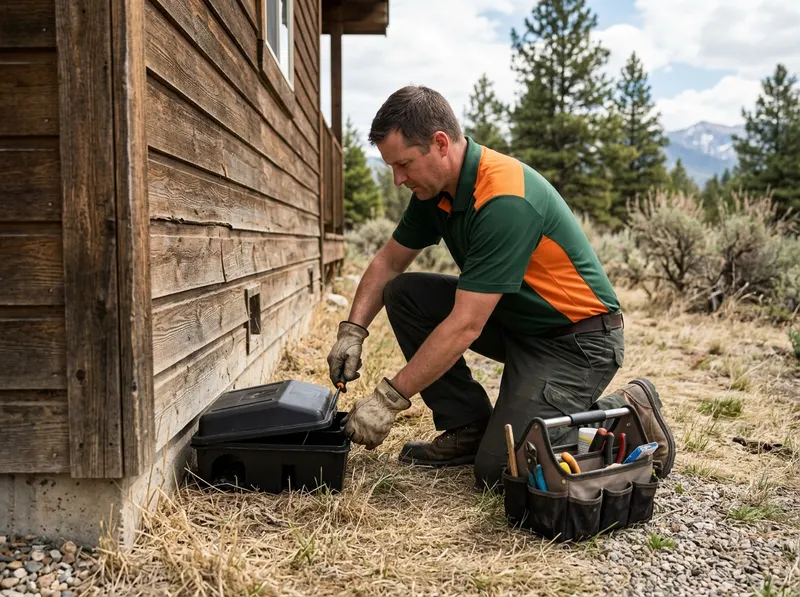
When cold weather descends through the Salmon River valley each October, field rodents migrate from riparian zones and sage flats into warm residential structures. Houses situated along Highway 93 and Highway 28 experience pressure primarily from deer mice, which carry hantavirus, and destructive bushy-tailed woodrats that strip structural wiring and insulation. Traditional suburban bait programs prove insufficient against mountain populations; an effective defensive perimeter demands physical exclusion. Steel hardware cloth measuring 1/4-inch must seal stone foundations, floor rim joists, and crawl space ventilation screens to stop adult rodents capable of penetrating an opening as small as a dime.
Properties in Courthouse Hill and Downtown Salmon often feature older river-rock footings and wood framing that require custom masonry patching, whereas rural outbuildings in Baker, Carmen, and Tendoy require galvanized flashing along heavy sliding barn doors. A single pair of deer mice produces up to 10 litters annually, meaning indoor mechanical snap traps must run concurrently with exterior exclusion to clear nesting adults before young reach reproductive maturity at 7 weeks. For riverside properties near Island Park or running north toward Shoup, unmaintained woodpiles within 30 feet of a residential perimeter create natural bridges that bypass ordinary ground-level traps.
Remediation succeeds through a precise multi-stage procedure. Step 1 involves an exhaustive perimeter scan of exterior foundations, water line penetrations, and soffits. Step 2 requires setting multi-point mechanical trap grids inside the crawl space, attic, and living footprint to eliminate the active population without secondary poisoning risks to local raptors. Step 3 implements physical barrier exclusion using copper mesh, steel plate, and exterior silicone sealants. Step 4 concludes with sanitation of nesting materials, followed by a mandatory inspection 7 to 10 days later to confirm zero trap activity.
Every job gets a firm, written price after a free on-site visit.
Tell us about your rodent control job in Salmon and we'll send a clear, written quote, usually the same day.
 Ravexio Pest Defense