Termite control in Salmon requires addressing the specific survival strategies of western subterranean termites in the Lemhi River Valley. Unlike coastal or southern regions with drywood varieties, Lemhi County…
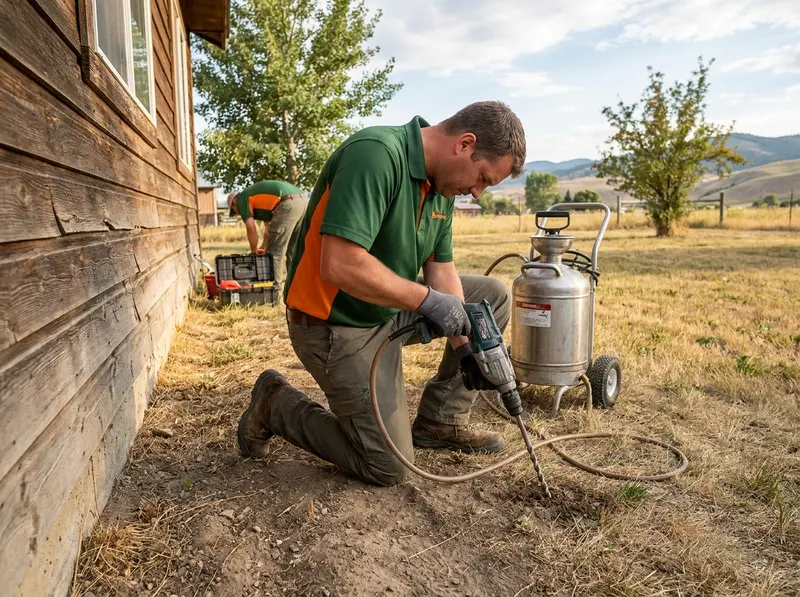
Termite control in Salmon requires addressing the specific survival strategies of western subterranean termites in the Lemhi River Valley. Unlike coastal or southern regions with drywood varieties, Lemhi County structures face subterranean colonies that nest deep below the winter frost line, often 24 to 36 inches down, and tunnel upward through concrete hairline cracks, stone rubble foundations, or pier blocks to consume cellulose. In riverfront cabins near Shoup or older residences built across Courthouse Hill and Brooklyn, high sub-slab moisture and spring groundwater shifts create sustained feeding zones. Effective eradication requires deep chemical soil barriers rather than superficial topical sprays that fail when ground temperatures freeze. The standard technical defense applies a non-repellent liquid barrier along foundation footings; foraging worker termites track the undetectable chemistry back to the central subterranean queen, neutralizing the satellite nest within 60 to 90 days.
Selecting the appropriate treatment protocol depends directly on foundation design and building hydrology. A continuous liquid termiticide trench suits monolithic slabs and stem-wall foundations found in Downtown Salmon, establishing an unbroken 6-inch-wide treated soil perimeter that isolates the wooden framing. Conversely, older ranches in Baker, Carmen, and Tendoy with river-rock crawl spaces or timber posts embedded directly in soil rely on low-pressure borate injections directly into load-bearing timbers paired with exterior hexachumuron or noviflumuron baiting arrays. The operational trade-off involves immediate perimeter saturation versus slow colony elimination: liquid perimeter treatments halt active entry within days but require physical ground excavation, whereas bait station matrices avoid soil disturbance around gardens near Island Park but require 4 to 12 weeks of seasonal colony feeding to collapse the subterranean population.
Structural moisture discipline serves as the primary barrier preventing subterranean termites from recolonizing mountain properties. Termites dehydrate rapidly in Idaho's semi-arid high desert; they survive exclusively by sustaining uninterrupted mud shelter tubes between subterranean soil water and structural wood. Properties adjacent to the Salmon River, the Lemhi Hole, or wet drainage channels along the base of the Beaverhead Range experience intense structural vulnerability when crawlspace soil relative humidity exceeds 70%. Remediating soil-to-wood ground contact, correcting downspout drainage outside sill plates, and encapsulating crawlspaces with heavy-duty 10-mil vapor barriers prevent subterranean foraging runs before colonies access mudsills. Routine annual monitoring ensures bait stations remain loaded with active growth regulators through seasonal ground freezes and high spring runoff.
Every job gets a firm, written price after a free on-site visit.
Tell us about your termite control job in Salmon and we'll send a clear, written quote, usually the same day.
 Ravexio Pest Defense